
Colors Flashcards
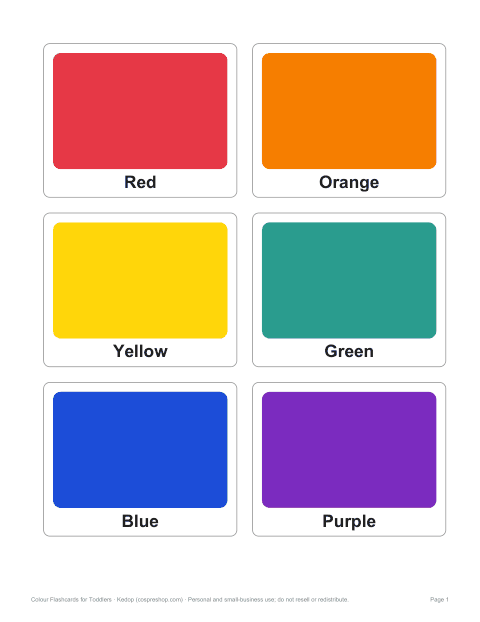
Bright, simple colour flashcards for toddlers and preschoolers. Each card shows a large swatch of colour with its name underneath, and the pack includes matching cards, a colour hunt sheet, a colour mixing chart and a colour-by-name page to turn practice into play.
- Instant download
- Editable Word & Excel
- Print-ready PDF
- 7-day refund
5 files · PDF, DOCX, XLSX
Colour Flashcards for Toddlers
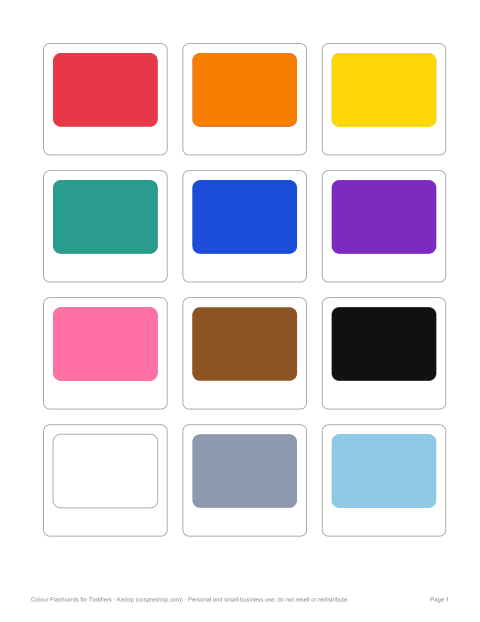
Twelve colour swatch flashcards, colour matching cards, a colour hunt sheet, a colour mixing chart and editable name cards.
- Colour flashcards (PDF)
- Colour matching cards (PDF)
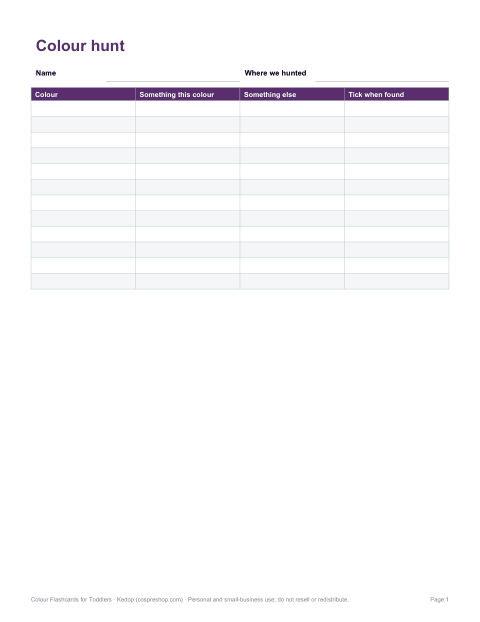
- Colour hunt sheet (PDF, DOCX, XLSX)
- + 2 more
$5.00 USD, one-time 5 files · about $1.00 each
- Instant download
- 7-day refund
- Secure checkout by Stripe
7-day money-back guarantee. Full refund within 7 days of purchase, even after you download.
Free sample: Colour Flashcards (PDF, 46 KB)
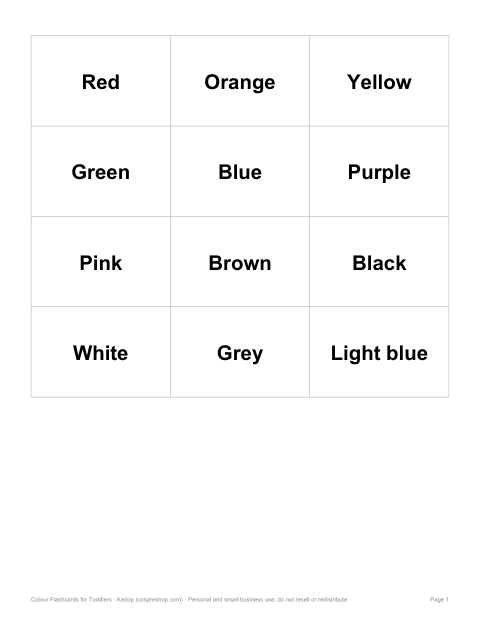
Colour Flashcards for Toddlers
Twelve colour swatch flashcards, colour matching cards, a colour hunt sheet, a colour mixing chart and editable name cards.
- Colour flashcards (PDF)
- Colour matching cards (PDF)
- Colour hunt sheet (PDF, DOCX, XLSX)
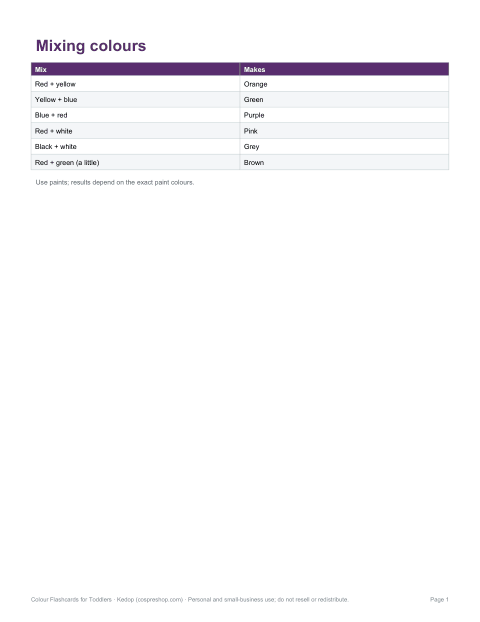
- Colour mixing chart (PDF)
- Editable name cards (DOCX)
Formats: PDF, DOCX, XLSX. Instant download after payment (link valid 72 hours, up to 5 downloads). AI-assisted: the templates were drafted with AI help and reviewed and laid out before publishing.
$5.00 USD, one-time 5 files · about $1.00 each
- Instant download
- 7-day refund
- Secure checkout by Stripe
7-day money-back guarantee. Full refund within 7 days of purchase, even after you download.
Free sample: Colour Flashcards (PDF, 46 KB)
Full refund within 7 days — see the refund policy and license.
Free printables
Single sheets you can print right now, no sign-up. The full pack adds every sheet in one download plus the editable files.
 Printable Colour Flashcards
 Printable Colour Matching Cards
 Printable Colour Hunt Sheet
 Printable Colour Mixing Chart
 Editable Name Cards Printable
Colours in the pack
Twelve colours are included: red (apples, fire engines), orange (oranges, carrots), yellow (bananas, the sun), green (grass, leaves), blue (the sky, the sea), purple (grapes, plums), pink (flamingos, cherry blossom), brown (tree trunks, chocolate), black (night sky, tyres), white (snow, milk), grey (clouds, elephants) and light blue (the sky on a clear morning). Pointing to real objects after showing a card helps children connect the word with the world.
How children learn colours
Most children begin to recognise and name colours between about 18 months and three years, though there is a wide range. They usually match colours before they can name them, and name them before they use them reliably in sentences. Colour words are abstract — “red” describes many different things — so children learn best from many examples: red apple, red car, red jumper. Flashcards give a clear anchor for each word, and games and everyday talk do the rest.
Activities with colour cards
- Colour hunt — show a card and find three things in the room of that colour.
- Match and sort — sort toys, blocks or socks onto the matching card.
- I spy colours — “I spy something green.”
- Colour of the day — wear it, eat it, find it.
- Mixing magic — use paint to mix two primary colours and find the card for the result.
- Memory game — print two sets and play pairs.
Colour mixing basics
With paints, red and yellow make orange, yellow and blue make green, and blue and red make purple. Adding white makes a colour lighter (a tint, such as pink from red), and adding black or its opposite makes it darker. The pack’s mixing chart shows these combinations for simple painting activities.
Tips for colour learning
- Start with two or three very different colours, such as red, blue and yellow.
- Use the colour word as a describing word: “the red cup”, not just “red”.
- Avoid quizzing constantly; model the words naturally in play.
- Praise attempts and gently repeat the correct word.
- If a child consistently confuses certain colours (especially red and green), mention it to a health professional — colour vision deficiency is common, particularly in boys.
Who it is for
Parents of toddlers and preschoolers, nursery and preschool teachers, childminders, speech therapists and English teachers working with young learners.
Formats
Print-ready PDF colour cards (six per US Letter page; print on A4) and activity sheets. Print in colour on card stock; laminate for durability.
Printing colours accurately
Printers vary in how they reproduce colours, and some shades (especially purple and light blue) can look different from the screen. Print one test page, and if a colour looks off, check ink levels or choose a “best” or “photo” quality setting. White is shown as a white card with an outline so it is still recognisable.
Colour words in everyday talk
The quickest way to build colour vocabulary is to use colour words naturally throughout the day: “Can you find your blue shoes?”, “Let’s pick the yellow banana”, “The bus is red”. Pair the word with the object each time, and give children choices that use colours (“the green cup or the orange cup?”). Flashcards then become a fun review of words the child already hears, rather than a test.
Colours in other languages
The editable name cards let you change the colour words into another language — useful for bilingual families and language classes. Print the English and second-language sets on different coloured card so they are easy to keep apart.
Frequently asked questions
What age do children learn colours?
Many learn to name colours between about 2 and 4 years, with wide variation.
Which colours should I teach first?
Start with a few very different ones, such as red, blue and yellow.
Do I need a colour printer?
Yes, the swatches need colour printing to be useful.
Can I change the words to another language?
Yes, with the editable name cards.
Was AI used to create the cards?
The cards were generated by script and the text drafted with AI assistance, then reviewed before publishing.